
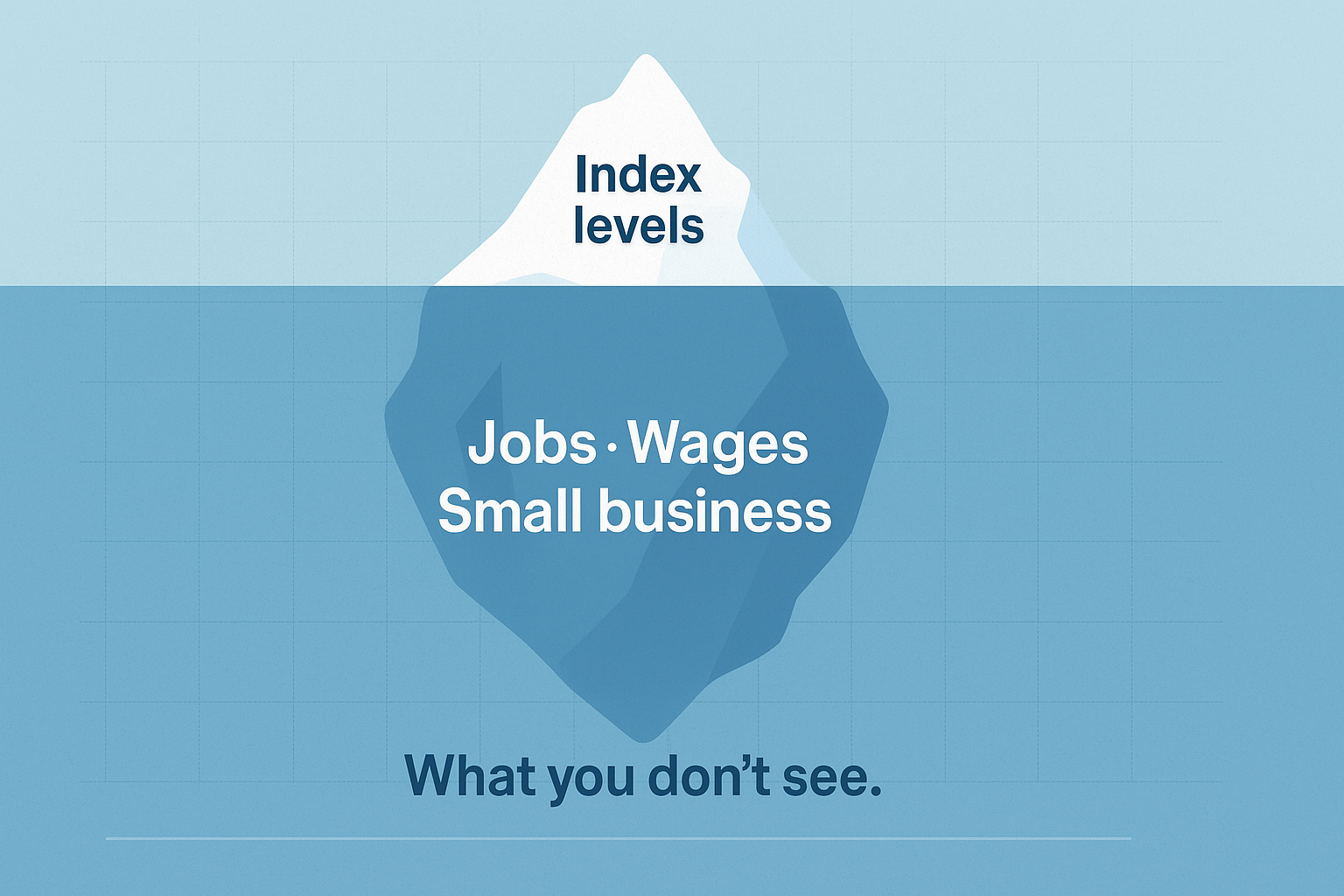



The SPX and TSX are at an all-time high now. Do these indices really reflect the overall health of the economy? Are they any good as bellwethers for the real economy?
An investment reporter at the Globe and Mail recently compared S&P/TSX index returns to Canadian housing gains. According to his research, a $100,000 investment in real state in 1980 is now worth $1.1 million. The same investment in that index would now be worth $4.8 million.
Is this comparison valid?
If you’re comparing two benchmarks, shouldn’t their constituents and methodology be held constant? We know that stock indices are periodically reconstituted and cap-weighted, and they remove laggards and add winners all the time.
If so, the comparison could be, at best, misleading and, at worst, meaningless.
An index comprised only of top performers does not reflect the broader economy. Not surprisingly, index returns and real-world activity have parted ways. In Canada, U.S. tariffs are biting—steel, aluminum, autos, and agriculture are under strain—while overall housing prices are down around 15% and GDP may drop as much as 1.5%.
It’s possible that the U.S. economy will soon enter a period of stagflation —stagnant growth, high inflation, and rising unemployment.
Since the pandemic, U.S. housing prices have increased by about 60% in most markets. Despite high interest rates, they haven’t come down. Renters, as a group, are most affected. Costs of living have gone up significantly. Wages haven’t kept up.
If I am not mistaken, there’s an undercurrent of discontent among a majority of the people with the state of the economy. On top of that, they are grappling with the massive economic and (geo)political changes unleashed by the new president of the world’s most powerful country.
Against this backdrop, an ongoing AI revolution is threatening to put large number of workers in numerous industries out of work, including ironically, software engineers. The effects you’re seeing are just at the very beginning.
Put all the pieces together, and the larger picture suggests the design of the indices is inherently flawed. Maybe they function perfectly as something traders can bet on via futures, options, and ETFs, but as a barometer of the real economy, how reliable are they?
If you run a business or a household budget, do the headline numbers match your reality?
Where do you see the biggest mismatch—jobs, wages, housing, credit?
What metric do you trust more than the S&P/TSX to gauge Main Street?
(Hai Van Le is the author of Into the Unknown: A Survival Thriller. The revised and illustrated edition is set for release on 10/10/25.)